Hindi: A Language of Literature, Research and Global Dialogue
From its rich literary heritage to international universities and emerging digital technologies, Hindi continues to connect people, ideas and cultures across borders.
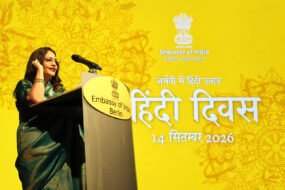
Berlin, 23 September 2026: The Embassy of India in Berlin organised Hindi Pakhwada 2026 to mark Hindi Diwas and celebrate the richness of the Hindi language.
Shraddha Mishra, Founder, CEO and Editor-in-Chief of Indo German Spectrum, participated as a distinguished guest and delivered an address on the history, evolution and literary journey of Hindi.
The occasion offered an opportunity to reflect on a larger question: What makes Hindi important not only for India, but also for the wider world?
Hindi is often recognised for its vast number of speakers and its presence in Indian cinema and popular culture. Yet its significance extends much further. It is a language through which generations have expressed philosophical ideas, challenged social inequalities, preserved cultural knowledge and told stories about the changing world around them.
Today, Hindi continues to find new audiences through literature, academic research, translation, digital technology and the global Indian diaspora.
More Than a Language of Communication
A language is more than a collection of words. It carries the memories, experiences and ideas of the people who use it.
Hindi reflects centuries of India’s literary, social and cultural development. Its vocabulary and expressive traditions have evolved through interactions among different communities, regional languages and literary movements.
Spoken by hundreds of millions of people, Hindi connects communities across India and beyond. It is heard in homes, classrooms, workplaces, films, music, journalism and digital media.
For Indian families living abroad, Hindi can also be an important connection with their cultural heritage. A familiar poem, a childhood story or a conversation with grandparents may carry memories and emotions that are difficult to express in quite the same way in another language.
For international learners, Hindi opens a window into Indian society, offering access to literature, films, everyday communication and cultural perspectives through the language in which they were originally expressed.
Hindi’s importance lies not only in how widely it is spoken, but also in the knowledge, creativity and human experiences it carries.
The Literary Journey of Hindi: A Living Heritage
The history of Hindi literature reflects the changing cultural and social landscape of India.
Early literary traditions included heroic narratives, devotional compositions and poetry that explored human relationships, spiritual questions and social values.
The Bhakti movement brought literary expression closer to ordinary people. Poets such as Kabir, Tulsidas, Surdas and Mirabai used accessible poetic forms to communicate devotion, philosophical reflection and ideas about human dignity.
Kabir’s verses questioned social divisions and religious formalism, while Tulsidas’s Ramcharitmanas became an enduring part of North India’s literary and cultural traditions. Surdas’s poetry explored devotion through the life of Krishna, and Mirabai’s compositions expressed a deeply personal spiritual relationship with him.
Their works continue to be read, sung, studied and interpreted across generations.
Later literary traditions developed new forms of poetic expression, placing greater emphasis on aesthetics, emotion and artistic composition.
The modern period brought another important transformation.
As India experienced colonial rule, social reform movements and the struggle for independence, Hindi writers increasingly explored questions of national identity, social inequality, poverty, women’s experiences and human dignity.
Bharatendu Harishchandra contributed to the development of modern Hindi literature and journalism. Munshi Premchand portrayed the lives of ordinary people through stories and novels that examined rural society, economic hardship and social relationships.
Writers and poets such as Mahadevi Verma, Suryakant Tripathi ‘Nirala’ and Ramdhari Singh Dinkar further enriched Hindi literature through their distinctive approaches to poetry, society and human experience.
Their contributions demonstrate how literature can preserve the spirit of an era while encouraging readers to examine the world around them.
Contemporary Hindi writing continues this tradition through new themes and perspectives. Migration, urbanisation, gender, technology, environmental concerns and diaspora identity have become important subjects for writers responding to a rapidly changing world.
Hindi literature is not simply a record of the past. It is an ongoing conversation between generations, cultures and contemporary society.
Hindi in Germany and the World of Academic Research
Hindi’s international relevance is also visible in universities and research institutions.
Academic engagement with Hindi and South Asian studies extends across Europe, North America and other parts of the world. Scholars explore languages, literature, history, philosophy, religious traditions, social change and contemporary cultural developments.
In Germany, institutions such as Heidelberg University and the University of Marburg have established traditions of South Asian academic study. International institutions, including SOAS University of London and the University of Chicago, also provide opportunities for academic engagement with Hindi and wider South Asian subjects.
For researchers, learning Hindi provides access to original literary works, historical material, contemporary publications and the voices of people whose experiences may not be fully represented in translated sources.
Hindi can be studied through several interconnected disciplines, including linguistics, comparative literature, translation, publishing history, gender studies, migration, digital humanities and language technology.
A researcher examining Indian social history may encounter Hindi newspapers, literary journals and personal accounts. Someone studying migration may explore the writings of Indian communities abroad. A student interested in contemporary cinema may discover how language influences storytelling, humour and cultural identity.
Such engagement creates opportunities for international scholars to understand Indian society through a wider range of perspectives.
For Indo German academic and cultural exchange, Hindi offers another pathway to explore Indian knowledge traditions and contemporary social experiences beyond English-language sources alone.
Why Hindi Matters in Professional and Digital Life
The value of learning Hindi is not limited to literary or academic interests.
Language knowledge can support professional communication in journalism, publishing, translation, education, tourism, cultural diplomacy and international business.
For German and European professionals working with Indian organisations or communities, understanding Hindi may help build stronger relationships and provide insight into local communication practices and cultural contexts.
English plays an important role in international business and education. Hindi, alongside India’s many other languages, can complement that communication by making information and services accessible to wider audiences.
The digital world has created another important area of opportunity.
Artificial intelligence, machine translation, speech recognition, voice assistants and digital archives depend on linguistic resources that reflect how people actually communicate.
Developing high-quality Hindi-language content, translations and technological tools can help more people access information and participate in digital services in their preferred language.
This also creates opportunities for writers, editors, translators, researchers and technology professionals to contribute to the future of Indian-language communication.
A language remains relevant not only when its literary heritage is preserved, but also when it can express the ideas, innovations and everyday needs of new generations.
Hindi and the Indian Diaspora: Keeping Cultural Connections Alive
For Indians living outside India, language often becomes an important part of family and cultural life.
In Germany, children growing up in multilingual environments may communicate in German at school, use English in international settings and hear Hindi or another Indian language at home.
These languages need not compete with one another. Each can offer a different way to connect with people, knowledge and cultural experiences.
Hindi literature, storytelling, music, theatre and community programmes can help younger generations discover aspects of Indian heritage while remaining fully engaged with the society in which they live.
At the same time, Hindi provides an opportunity for German and international audiences to explore Indian culture through original literary and artistic expression.
Translation and multilingual publishing can bring these worlds closer together, allowing ideas to travel between languages without losing sight of their cultural origins.
This exchange is especially meaningful for media platforms that work across national and linguistic boundaries.
Indo German Spectrum: Connecting Languages and Cultures
At Indo German Spectrum, language is an important part of our mission to strengthen understanding and meaningful exchange between India and Germany.
Our platform communicates with an international audience through English and German while also developing Hindi content and publications.
This multilingual approach reflects a simple belief: cultural exchange becomes richer when people can encounter ideas through different languages and perspectives.
Supporting Hindi does not mean limiting communication to one language. It means creating space for Indian literature, cultural knowledge and contemporary experiences to reach audiences in their original linguistic context while also making them accessible through translation and international media.
Through articles, interviews, publications, cultural stories and community engagement, Indo German Spectrum seeks to connect writers, researchers, artists, educators and media professionals who contribute to dialogue between India and Germany.
We also aim to encourage younger generations to explore their linguistic heritage and provide opportunities for international readers to discover the diversity of Indian thought and expression.
The celebration of Hindi Pakhwada 2026 at the Embassy of India in Berlin offered a meaningful reminder of the role language plays in bringing communities together.
Hindi belongs to a rich literary past, but its journey is far from complete. Its future is being shaped wherever people continue to speak it, study it, write in it, translate it and introduce it to new audiences.
From the poetry of Kabir and Mirabai to contemporary literature, international research and emerging digital technologies, Hindi continues to connect memory with modernity and cultural heritage with global dialogue.
For Indo German Spectrum, contributing to this journey is part of a wider commitment to building connections between people, cultures and ideas across borders.
Share Your Knowledge and Creativity with Indo German Spectrum
Are you a writer, researcher, translator, journalist, student or creative professional interested in literature, culture, education or international media?
Indo German Spectrum welcomes contributors and volunteers who wish to share knowledge, develop meaningful content and participate in cultural and intellectual exchange between India and Germany.
Explore opportunities to contribute through articles, interviews, research, translation and creative media projects.
Website: www.indo-germanspectrum.com
Email: indogermanspectrum@gmail.com